You have a software project and a stack of proposals. One is from a freelancer, one from a five-person studio, one from a mid-sized agency, one from a large consulting firm and one from an offshore company. The prices are all over the place, and every one says it is the right fit.
Small software development companies are often a strong choice for small and mid-sized businesses, but company size alone tells you very little. The best small software development company is not the one with the largest team, the lowest hourly rate or the longest technology list. It is the one that understands your business problem, communicates clearly, has the technical capability to build what you need and stays accountable throughout the project.
This guide gives you a 10-point checklist for evaluating providers, the questions to ask, the red flags to watch for and a simple scoring framework for comparing them.
What is a small software development company?
A small software development company is a boutique studio, agency or consultancy that designs and builds custom software with a compact team, usually working with a limited number of clients at a time. There is no official employee threshold, so judge "small" by how the company actually operates.
The category includes:
- Boutique software studios
- Small development agencies
- Product development firms
- Specialized engineering teams
- Small IT and software consultancies
Company size can be measured several ways:
- Team size
- Number of active clients
- Development capacity (how many projects they can run at once)
- Geographic footprint
- Number of disciplines in-house (design, QA, DevOps)
Review platforms such as Clutch group companies into bands like 2 to 9, 10 to 49 and 50 to 249 employees. Treat those bands as self-reported, and ask the company directly how many people would work on your project.
Small software development company vs. large agency
FactorSmall software companyLarge agencyDirect founder or senior accessCommonUsually through account managersCommunicationDirect, fewer layersMore structured, more handoffsFlexibilityHighLower, more process-boundSpecialized expertiseDeep in a few areasBroad across many areasProject capacityLimitedHighProcess maturityVaries widelyUsually formalizedRedundancyLower, key-person riskHigher, larger benchCost structureOften lower overheadHigher overhead built into ratesLarge enterprise capabilityLimitedStrongPersonal attentionHighVaries by account size
Neither model is better in every case. Small software companies offer more direct access to senior people, less bureaucracy, faster decisions and more personal attention. The trade-offs are a smaller bench of specialists, dependency on key people, limited capacity and less redundancy if someone leaves.
Small companies may be better for:
- Small business software
- MVPs
- Custom internal tools
- Focused product builds
- Projects that need close collaboration
Large agencies may be better for:
- Large enterprise transformations
- Very large teams
- Multi-country implementations
- Complex compliance environments
- Projects that need many specialized departments
The 10-point checklist for choosing a small software development company
Use these ten checks for every provider on your shortlist. Each one should be backed by evidence, not just a sales promise.
1. Can they understand your business problem?
A good software partner asks about your current workflow, the business problem, who the users are, which tools you already use, the outcome you want, your constraints (budget, deadline, regulation) and how you will measure success.
Red flag: a detailed proposal after a 20-minute call. If they did not understand the problem, the estimate is a guess.
2. Do they have relevant technical experience?
Look for experience with relevant technology, similar products, similar integrations, similar architecture, comparable security requirements and, where it matters, your industry.
There is a big difference between "We use React" and "We have successfully built products with requirements similar to yours." Technology familiarity is useful. Relevant problem-solving experience matters more.
3. Who will actually build the software?
Ask:
- Who is on the team?
- Are developers employees or contractors?
- Who is the technical lead?
- Who handles QA?
- Who manages the project?
- Will the people in the sales process stay involved?
In a small company, the people you meet are often the people who build. Confirm it. Some firms subcontract work without telling clients, which affects quality, communication and code ownership.
4. Can they show relevant work?
Ask for case studies, product examples, public applications you can try, technical examples and client references. Do not rely on logos alone. A relevant project for a business like yours is more useful than an impressive but unrelated client list.
5. Do they have a clear development process?
A credible company can explain how it moves through:
- Discovery
- Requirements
- UX/UI design
- Architecture
- Development
- QA
- Deployment
- Post-launch support
The methodology can differ (agile sprints, milestone-based delivery), but you should be able to understand it and see where you will review progress.
6. How do they handle scope changes?
This matters especially for small businesses, because change is where budgets break. Ask what happens when requirements change, how changes are priced, who approves them and how they affect the timeline.
Good answers involve a written change order process, a prioritized backlog of ideas for later, and iterative development that lets you adjust between milestones without surprise invoices.
7. Do you own the code and intellectual property?
Clarify ownership of all of the following before development begins:
- Source code and repository access
- Design files
- Documentation
- Cloud infrastructure accounts
- Domain names
- Databases and data
- Third-party service accounts
- Intellectual property rights
The safest setup is for code, cloud and third-party accounts to be created in your name from day one. This is not legal advice; have a lawyer review the contract's IP and ownership terms.
8. How do they handle security and quality?
Ask how they approach authentication, authorization, data protection, secure coding, dependency updates, automated and manual testing, QA, backups and monitoring. For regulated products such as healthcare or financial software, ask about the extra controls and documentation required.
Not every project needs enterprise-grade security architecture. A good partner matches security effort to the sensitivity of your data.
9. What happens after launch?
Launch is the start of the software's life, not the end. Ask whether they provide bug fixes, maintenance, monitoring, hosting support, new features, security updates and ongoing product iteration, and how each is priced.
10. Does the commercial model make sense?
Common models are fixed price, time and materials, retainer, dedicated team and milestone-based pricing. The model should match the project's uncertainty. A well-defined internal tool suits fixed price; a new product that will change as you learn may not suit a rigid fixed-price contract. Our pricing guide for small business software compares the models in detail.
Questions to ask a small software development company before hiring
Question 14 matters most with small software companies, where one person may hold a lot of knowledge. For more on vetting agencies, see 7 questions to ask MVP agencies.
Red flags when hiring a small software development company
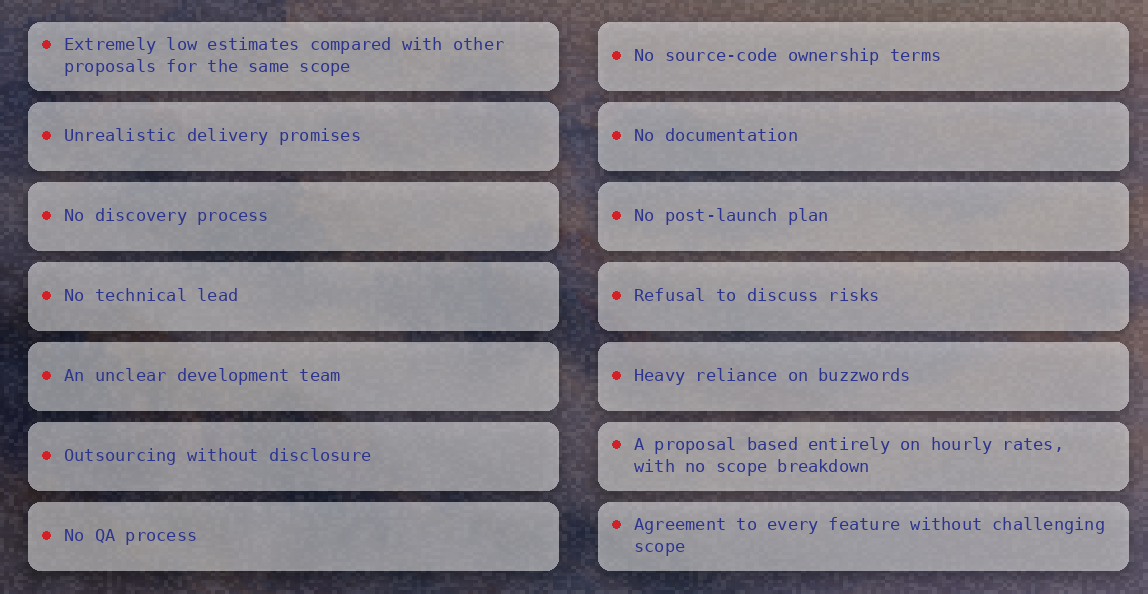
A good development partner should occasionally tell you "no." An agency that questions an unnecessary feature is protecting your budget. One that agrees with everything is either not thinking about your business or planning to bill for it later.
Local vs. remote software development companies
Local development companyRemote development companyAdvantagesTime-zone alignment; easier meetings; in-person workshops; understanding of the local marketLarger talent pool; potentially lower costs; flexible team structuresDisadvantagesHigher rates in some markets; smaller local talent poolTime-zone differences; communication challenges; more coordination
Location matters less than communication, accountability, technical capability and product understanding. A remote team in your time zone that communicates well can outperform a local team that is hard to reach. Our guide to local vs. offshore MVP agencies covers this trade-off in more depth.
How much does a small software development company cost?
There is no single rate for small software companies. Prices depend on location, seniority and the type of project, and small firms do not automatically charge less than large ones.
As market estimates:
- Clutch reports that most development firms on its platform charge $25 to $49 per hour, with many US firms in the $50 to $99 range and some at $100 to $149 or more.
- Keyhole Software's 2026 benchmarks put North American developers at roughly $55 to $100 per hour for junior engineers, $90 to $149 for mid-level and $125 to $250+ for senior.
Small companies usually price work in one of four ways: hourly rates, fixed project costs, monthly retainers or a dedicated team. What moves the price:
- Complexity
- Team size and seniority
- Technology
- Geography
- UX/UI requirements
- Integrations
- Security
- Timeline
- Maintenance
Smaller firms often have lower overhead, but a senior boutique team can still charge more per hour than a large offshore agency. Compare total project cost for the same scope, not hourly rates. For project-level ranges, see how much custom software costs for a small business.
How to compare three small software development companies
Score each company from 1 to 5 on each area, multiply by the weight and add up the totals.
Evaluation areaWeightCompany ACompany BCompany CRelevant experience15%Technical capability15%Product understanding15%Communication10%Development process10%Security and QA10%Pricing transparency10%Ownership and IP5%Post-launch support5%Cultural and working fit5%
These weights are illustrative. If you are in a regulated industry, raise security; if you have no technical staff, raise communication and product understanding. Score from evidence you have seen (case studies, reference calls, the proposal itself), not from the sales presentation.
List of small IT companies in the USA: how to build a verified shortlist
A giant list of small IT companies in the USA would not help you much. Directories change constantly, company sizes are self-reported, and "top" lists are often paid placements. A short, verified list of three to five companies that fit your project is far more useful.
How to build one:
- Start with review platforms. Filter Clutch or similar directories by service, US location and company size (for example, 2 to 9 or 10 to 49 employees). Read the verified reviews, not just the star rating.
- Check the official website. Confirm the services they offer, a real US address and recent case studies.
- Match specialization. Keep companies that have built something like your project: internal tools, customer portals, SaaS, mobile or AI.
- Verify size and team. Ask how many people work there and who would build your project. Do not rely on a directory band alone.
- Check references. Speak to one or two past clients with similar projects.
- Score them. Use the weighted framework above.
What makes a small US software company worth considering: clear evidence of relevant work, named senior people you can talk to, transparent pricing, written ownership terms and a support plan after launch.
Example profile: Codesmith
Codesmith publishes this article. The following is company-reported and review-platform information, not an independent ranking.
See Codesmith's custom software development for small businesses page for services and fixed-price packages.
From Our Work: What Clients Get From a Small Team
We are a small software company, so we can describe the trade-offs from the inside.
The trade-off is capacity. A small company is not the right fit for a program that needs dozens of engineers at once, and a good one will tell you so.
Our small business software team is happy to tell you honestly whether we fit your project.
When should you choose a small software company?
A small software company may fit whenA larger company may make more sense whenYou need close collaborationYou need hundreds of developersThe project is relatively focusedYou have complex enterprise procurementYou want senior-level accessYou need many specialized teamsYou need flexibilityThe project spans multiple countriesYou are building an MVPYou need extensive compliance or enterprise transformation capabilitiesYou need a custom internal toolYou want a long-term product partner
If you are choosing a small business software development service for a first build, see our guides to startup MVP development and SaaS MVP development.
Not sure custom software is the right move yet? Start with the benefits and drawbacks of custom software development.
Conclusion: choose evidence, not size
Don't choose a software development company because it has the lowest price, the biggest client logo or the longest technology list. Choose the company that can demonstrate:
Relevant experience + strong technical judgment + clear communication + transparent pricing + ownership + accountability.
For many small businesses, small software development companies offer a closer working relationship and direct access to the people actually building the product. But treat company size as one evaluation factor, not the deciding one. Shortlist three providers, run them through the checklist and score them on evidence.
FAQs on small software development company
What is a small software development company?
A boutique studio, agency or consultancy that builds custom software with a compact team and a limited number of clients at a time. There is no official size threshold.
Are small software companies cheaper than large agencies?
Not always. They often have lower overhead, but rates depend more on location and seniority than size. Compare total cost for the same scope.
How do I choose a small software development company?
Check that they understand your problem, have relevant experience, name the people who will build it, show similar work, explain their process, handle changes clearly, give you ownership, take security and QA seriously, support you after launch and offer a pricing model that fits your project.
What should I ask a software development company before hiring them?
Ask what they would change about your idea, what the estimate includes and excludes, who will do the work, how changes and overruns are handled, who owns the code and what happens after launch.
Is it better to hire a local or remote software company?
Local helps with meetings and time zones; remote widens your options and may cost less. Communication, accountability and capability matter more than location.
How much does a small software development company cost?
Rates vary widely. Clutch reports most firms on its platform charge $25 to $49 per hour, while US firms more often charge $50 to $149 or more. Project cost depends on scope.
What is the difference between a small software company and a freelancer?
A small company usually provides a team (development, design, QA, project management) and continuity if one person leaves. A freelancer is one person, which can cost less but adds key-person risk.
Should a small business hire a software development agency?
Yes, if you need custom software and don't have in-house developers, and if off-the-shelf tools can't do the job. For a narrow task, a freelancer or an existing tool may be enough.
How can I tell if a software development company is reliable?
Look for relevant case studies, verified reviews, references you can call, a clear process, written ownership terms and honest discussion of risks.
Who owns the software after development?
Whoever the contract says. Make sure it states that you own the source code, designs, data and accounts, and have a lawyer review the IP terms.